




Not All Stars Form on Circular Orbits
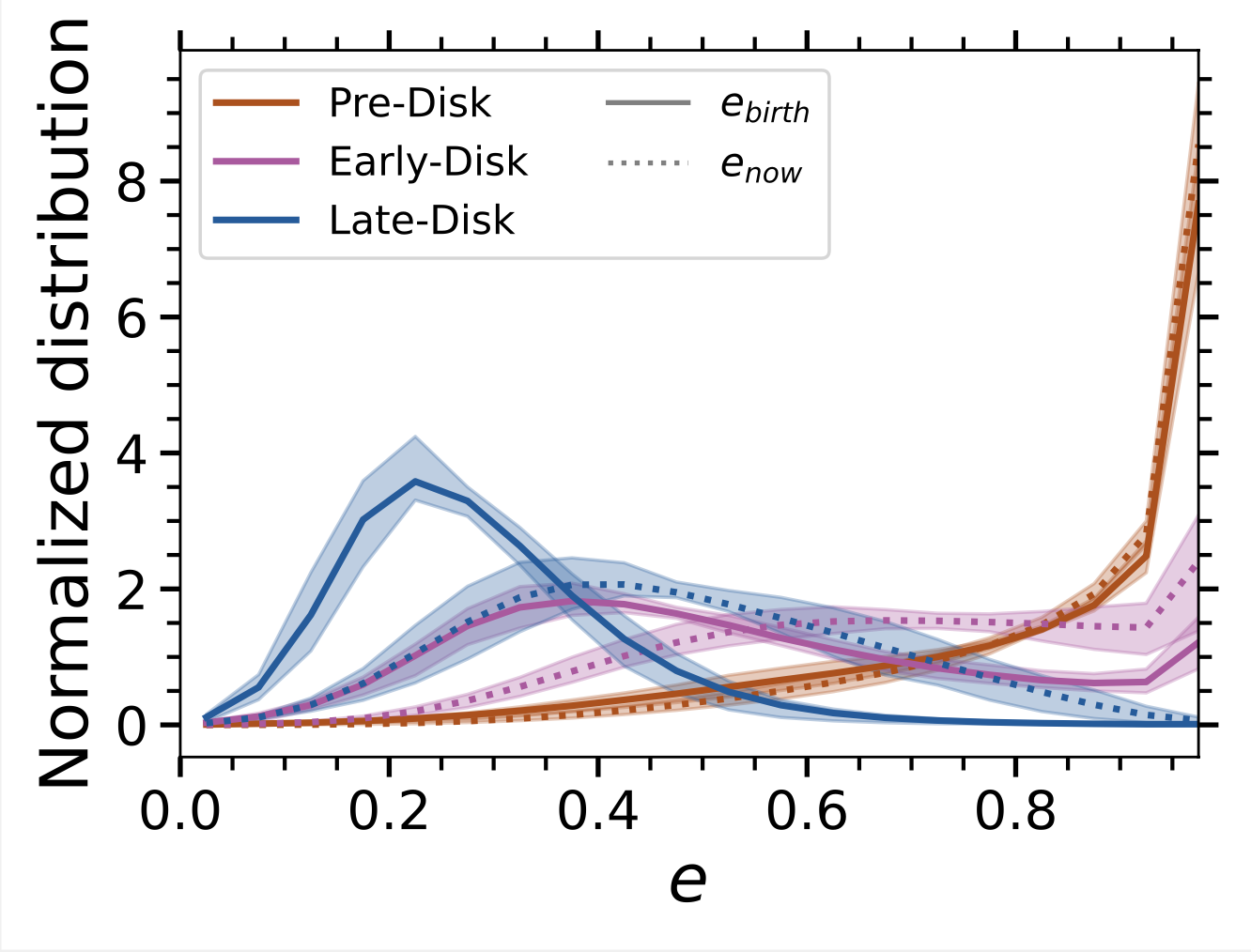
Because galaxies form "upside down," it's useful to group stars by when they formed relative to the disk's settling: before the disk formed (pre-disk, old stars), after it first became rotationally dominated (early-disk, moderately old stars), and after it fully settled into a rotationally supported disk (late-disk, younger stars). This figure shows the distribution of orbital eccentricities for each population at birth (solid lines) and today (dotted lines), with a value of 1 corresponding to a purely radial orbit and a value of 0 being perfectly circular. Most stars in FIRE do not form on perfectly circular orbits, which matters when trying to recover a star's birth conditions from its present-day orbit alone. Each population also occupies distinct eccentricities at both birth and today, tracing the disk's settling from turbulent to disky.